


Category: Housing Placement & Landlord Infrastructure
Current PULL Score: 26 / 31
Recommendation: Partner
Position: Procurement-ready housing placement infrastructure partner with a scalable landlord engagement model.
About This Scorecard
Healthcare organizations rarely purchase housing inventory. They purchase operational capabilities that improve placement reliability, expand housing access, strengthen discharge pathways, and reduce avoidable utilization. This scorecard evaluates Housing Connector through that procurement lens. Rather than measuring mission, reputation, or charitable impact, the PULL Score assesses the characteristics that most influence healthcare purchasing decisions: alignment with high-cost operational failures, funding architecture, measurable operational value, financial defensibility, operational risk, communication clarity, and procurement readiness. The objective is to help healthcare executives, investors, and strategic partners determine whether Housing Connector is positioned to support durable healthcare contracting.
Housing Connector occupies a distinct position within the housing-for-health market. Rather than delivering direct clinical services or owning housing assets, the organization functions as housing-market infrastructure by recruiting landlords, mitigating leasing risk, and unlocking private-market housing for people exiting homelessness. This operating model addresses one of the largest constraints facing healthcare-funded housing programs: the inability to convert housing navigation into successful placement because adequate housing inventory is unavailable. Publicly reported results include more than 12,500 people housed, 3,800 property partners, 400 community partners, and an 88% one-year housing retention rate, demonstrating meaningful operating scale across multiple markets.
The strongest procurement opportunity lies in pairing Housing Connector with Medicaid-funded housing navigation, tenancy supports, hospital discharge programs, and managed-care housing initiatives where placement speed is the limiting factor rather than care coordination. The remaining diligence centers on healthcare-specific contracting, payer attribution, reimbursement methodology, and purchaser-level financial outcomes, as public evidence supporting direct payer contracts remains less mature than the organization’s housing placement performance.
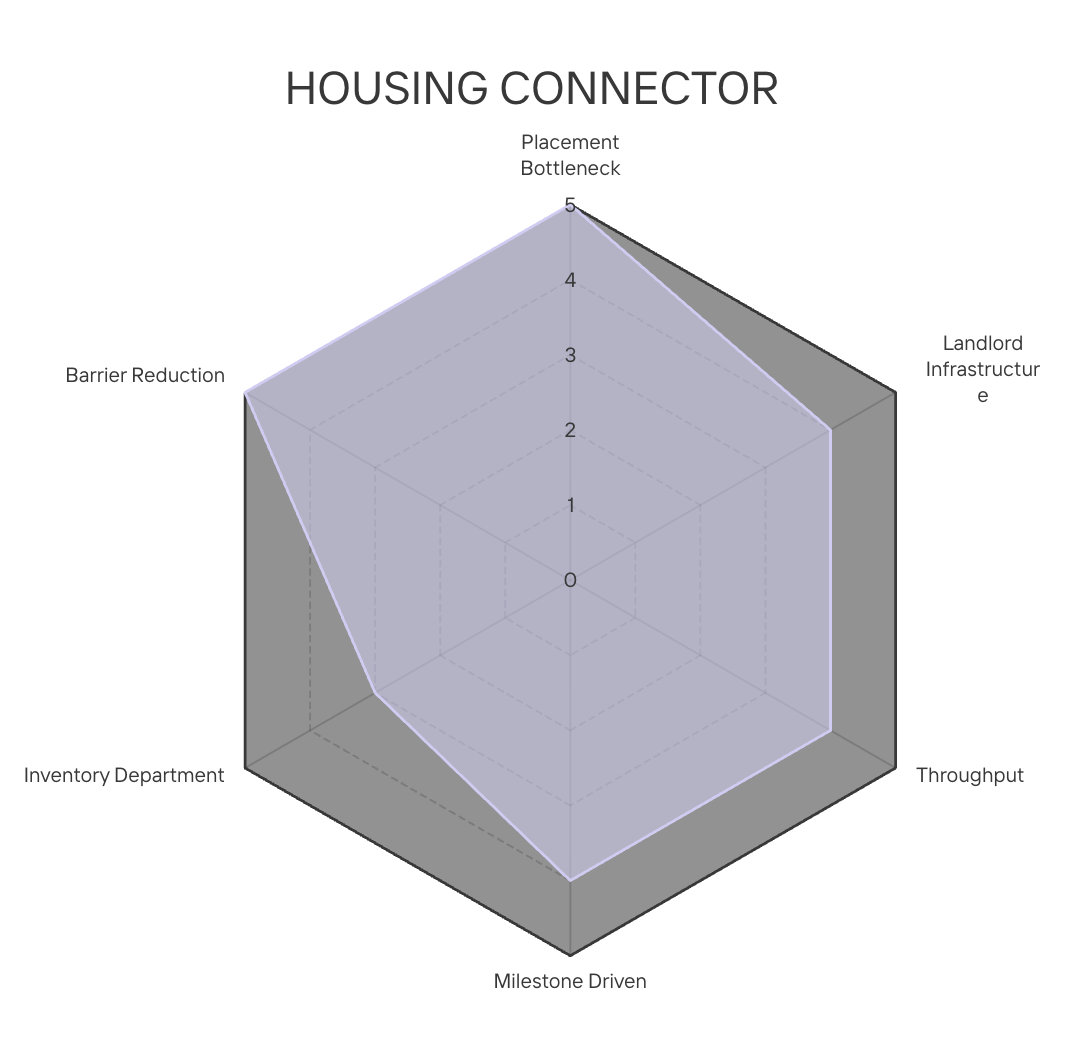
NEEDS ALIGNMENT: 5 / 5
Housing inventory bottlenecks
Delayed housing placement remains one of the primary reasons medically and socially eligible individuals fail to transition successfully out of hospitals, shelters, and intensive care management programs despite already qualifying for housing-related services. Housing Connector addresses this operational bottleneck by expanding the supply of immediately accessible private-market housing through landlord recruitment, risk mitigation, reduced screening criteria, and a technology-enabled marketplace connecting community organizations with available units. The organization reports more than 12,500 individuals housed, 3,800 property partners, 400 community partners, and 88% one-year housing retention, demonstrating that its operating model is designed to improve placement throughput rather than provide direct clinical services.
The procurement need extends beyond housing navigation. Mature Medicaid housing programs increasingly reimburse housing transition, tenancy supports, and care coordination, yet these services cannot produce measurable outcomes when appropriate housing inventory is unavailable. Housing Connector strengthens this portion of the operating pathway by reducing landlord risk, increasing available units, and shortening the time between referral and lease-up without requiring healthcare organizations to own or develop housing assets. As states continue expanding Medicaid-funded housing supports, landlord engagement and housing placement infrastructure become increasingly important procurement capabilities because they determine whether authorized housing services can be successfully executed.
EXPENDITURE TRANSPARENCY: 4 / 5
Landlord infrastructure
Housing Connector’s expenditure case is strongest because the buyer is funding a defined operating layer: landlord recruitment, vacancy access, risk mitigation, lease-up coordination, and post-placement support. Housing Connector states that its model helps property partners by addressing financial and resident challenges, while streamlining housing search for service providers through its Community Hub. It also discloses landlord-facing supports that include up to $5,000 in damage mitigation, a three-month rent guarantee, vacancy-loss support, and a single point of contact for financial support and conflict mediation.
The funding architecture is understandable because Housing Connector is not asking healthcare buyers to own housing assets. Medicaid policy generally permits housing-related services, such as assistance finding and securing housing, while limiting payment for rent or room and board except in narrow circumstances. That makes Housing Connector’s model a better fit for braided financing, where healthcare dollars support placement infrastructure and tenancy-related services while housing agencies, cities, philanthropy, or separate subsidy programs cover rent, guarantees, and flexible assistance.
The score remains a 4 because public sources do not provide enough purchaser-specific pricing to fully underwrite contract economics before diligence. Housing Connector’s FAQ says the organization is funded through approximately 70% public dollars and 30% private dollars, and its 2024 impact report says $2.1 million was secured for two years of Austin operations, but public materials do not disclose standardized healthcare pricing, PMPM rates, placement fees, margin assumptions, or payer-specific reimbursement structures.
SAVINGS ESTIMATION: 4 / 5
Placement throughput
Housing Connector’s financial value is created by improving placement throughput rather than delivering direct clinical services. By expanding landlord participation, increasing available housing inventory, and shortening the path from referral to lease-up, the organization helps healthcare buyers move eligible members into stable housing more efficiently. Faster placement can reduce discharge delays, improve housing-navigation conversion, strengthen tenancy retention, and increase the operational effectiveness of Medicaid-funded housing supports, particularly for medically and behaviorally complex populations.
The broader evidence supporting housing stability is strong. Oregon’s Medicaid evaluation found affordable housing was associated with a 12% reduction in Medicaid expenditures, an 18% reduction in emergency department utilization, and a 20% increase in primary care utilization.
The score remains a 4 because Housing Connector’s contribution is operational rather than directly clinical. The organization clearly improves one of the principal constraints limiting housing-for-health programs, but financial performance ultimately depends on the healthcare intervention surrounding the placement, including housing navigation, tenancy supports, care management, and discharge coordination. Publicly available evidence demonstrates strong housing placement outcomes, while purchaser-specific attribution to claims-visible savings has not yet been independently published.
BREAKEVEN: 4 / 5
Housing Connector’s financial model aligns with milestone-based procurement because value is demonstrated through measurable operational outputs rather than waiting for long-horizon utilization outcomes. Referral acceptance, landlord engagement, unit identification, lease-up, move-in, housing retention, and placement timelines can all be measured within existing contract periods, allowing healthcare buyers to evaluate implementation performance before downstream medical utilization changes are fully realized. Housing Connector publicly reports housing placements, landlord participation, and long-term housing retention, creating operational milestones that fit well within healthcare contracting and performance management.
The score remains a 4 because the public evidence supports operational value more strongly than purchaser-specific financial validation. Housing Connector demonstrates a credible pathway for improving placement throughput and housing access, but publicly available materials do not disclose standardized healthcare reimbursement rates, purchaser-specific return on investment, or claims-based analyses linking faster housing placement to healthcare savings. The break-even case is therefore strongest for buyers already operating housing navigation, tenancy supports, or discharge programs where placement speed is a measurable operational constraint.
RISK & SENSITIVITY: 3 / 5
Housing Connector's operating model is well established, but procurement performance remains dependent on factors that extend beyond the organization's direct control. Successful placement requires sufficient private-market housing inventory, continued landlord participation, available rental assistance, and coordination among healthcare organizations, housing navigators, and community partners. In constrained rental markets, these external conditions can lengthen placement timelines even when referral management and landlord engagement are functioning effectively. Housing Connector addresses several of these risks through landlord recruitment, financial risk mitigation, and ongoing property-owner support, but market availability ultimately remains outside the organization's control.
Healthcare procurement risk also remains centered on attribution rather than operational capability. Housing Connector publishes meaningful housing placement and retention outcomes, but publicly available evidence linking those operational metrics to purchaser-specific healthcare utilization, reimbursement performance, or return on investment remains limited. Buyers should therefore evaluate Housing Connector as infrastructure that improves placement capacity rather than as a stand-alone medical cost-reduction intervention. Contract diligence should focus on referral throughput, placement timelines, housing retention, and integration with existing housing navigation and care-management workflows.
COMMUNICATION & PACKAGING: 5 / 5
Housing Connector communicates its operating model with unusual clarity for a housing-for-health organization. Public materials consistently define the organization’s role as expanding housing access by recruiting landlords, reducing leasing barriers, and accelerating placement for people exiting homelessness rather than positioning itself as a traditional housing provider or clinical service organization. The result is a procurement narrative that clearly distinguishes the service being purchased from the housing asset itself, making it easier for healthcare buyers to evaluate where the organization fits within housing navigation, tenancy support, and discharge stabilization strategies.
The organization’s public reporting reinforces that clarity through measurable operating metrics, including housing placements, landlord participation, community partnerships, and housing retention, rather than relying primarily on mission-based outcomes. For healthcare executives, the purchasing decision is straightforward: Housing Connector provides placement infrastructure that expands the practical capacity of existing housing-for-health programs. The remaining diligence centers on contract economics and purchaser-specific financial performance rather than understanding the service itself.
EQUITY BONUS +1
Market Access
Housing Connector’s equity model is embedded in how it expands access to the private rental market rather than through a standalone equity initiative. The organization works with landlords, community organizations, and housing providers to reduce screening barriers that disproportionately affect people exiting homelessness while increasing access to existing private-market inventory. By improving placement opportunities within the conventional rental market, the model broadens housing access without requiring new housing development.
Procurement Assessment
Contract Readiness — 8 / 10
Housing Connector is well positioned for contracts focused on housing placement, landlord engagement, and healthcare-supported housing navigation. Its operating model aligns with emerging Medicaid housing-support programs that increasingly reimburse housing-related services rather than housing itself. The score remains below a perfect 10 because public evidence of payer-specific contracts, reimbursement methodologies, and standardized healthcare purchasing remains limited.
Evidence Strength — 8 / 10
The organization reports substantial operational outcomes, including more than 12,500 individuals housed, 3,800 property partners, and an 88% one-year housing retention rate, providing meaningful evidence that its landlord engagement model performs at scale. However, the published evidence focuses primarily on housing outcomes rather than healthcare utilization, limiting direct validation of medical cost savings.
Operational Scale — 9 / 10
Housing Connector has built one of the largest landlord engagement networks operating in the housing-for-health market. Rather than depending on individual housing developments, the organization leverages thousands of participating property owners and hundreds of community organizations, creating infrastructure that can expand across multiple markets with less capital intensity than traditional housing development.
Renewal Durability — 8 / 10
Renewal potential is strong because landlord infrastructure remains valuable regardless of the specific healthcare program purchasing housing-related services. As Medicaid housing navigation, tenancy supports, behavioral health stabilization, and hospital discharge initiatives expand, placement capacity becomes increasingly difficult to replace internally. Long-term renewal will depend on demonstrating healthcare-specific performance alongside housing placement outcomes.
Financial Durability — 8 / 10
Housing Connector appears financially stable as a growing nonprofit organization with diversified partnerships and demonstrated operating scale. The organization benefits from an infrastructure model that avoids the substantial capital requirements associated with owning housing assets. Remaining diligence should evaluate contract concentration, payer diversification, and long-term reimbursement strategy as healthcare purchasing expands.
Implementation Burden — 6 / 10
Implementation is moderate. Buyers do not need to construct housing inventory, but successful deployment requires coordination among hospitals, health plans, community organizations, landlords, housing navigators, and subsidy programs. The model performs best when integrated into an existing housing-support ecosystem rather than operating independently.
Audit Survivability — 8 / 10
Housing Connector’s operating model naturally produces measurable placement metrics, landlord participation data, referral tracking, and housing retention outcomes that support procurement oversight. The remaining opportunity is greater public visibility into healthcare-specific reporting, encounter documentation, and purchaser-level performance measures.
Financial Impact — 8 / 10
Financial impact comes primarily through faster housing placement rather than direct clinical intervention. Improved placement capacity supports hospital discharge efficiency, reduces delays associated with housing shortages, increases conversion of housing navigation referrals, and strengthens tenancy outcomes for high-risk members. These mechanisms are financially meaningful but depend on integration with healthcare delivery partners to produce measurable claims-based savings.
Quality Impact — 8 / 10
Housing Connector improves quality by increasing access to stable housing, strengthening continuity across community partners, and reducing placement failures that interrupt recovery and long-term care management. The organization creates infrastructure that supports broader housing-for-health strategies rather than delivering direct healthcare services itself.
Regulatory Alignment — 9 / 10
Housing Connector aligns closely with the direction of Medicaid housing policy. Mature housing-for-health markets increasingly reimburse housing navigation, tenancy supports, landlord engagement, and placement-related services through managed care, 1115 demonstrations, Community Supports, and Health-Related Social Needs pathways. The organization’s capabilities fit directly within these emerging procurement categories.
COMPETITIVE COMPARISONS


For more:
