
KEEP ELIGIBLE MEMBERS COVERED
A buyer's guide to Medicaid coverage continuity, administrative churn, and the emerging infrastructure built to prevent it.

SOCIAL CARE CATEGORY: COVERAGE CONTINUITY
CATEGORY STAGE: DEVELOPING ⇈
WHY THIS MATTERS NOW
Coverage continuity is becoming one of the most financially consequential operational challenges in Medicaid.
The Medicaid unwinding demonstrated that many members lost coverage for procedural reasons. Millions of disenrollments occurred for procedural reasons, exposing plans, providers, and states to enrollment disruption, reimbursement loss, and increased administrative burden.
The next phase of Medicaid policy is likely to increase those pressures.
Current drivers include:
Six-month renewals beginning for expansion populations in 2027
Increased administrative workload for plans and state agencies
Unlike many social-care categories, coverage continuity does not depend on long-term utilization reduction to demonstrate value.

For providers, the pathway is equally direct:
Coverage Restored → Reduced Self-Pay Exposure → Recovered Reimbursement
This makes coverage continuity one of the few social-care categories where financial impact can often be evaluated within the same contract cycle.
WHAT MAKES THIS A CATEGORY?
While the organizations in this category operate at different points in the eligibility lifecycle, they are responding to the same operational and financial problem: coverage loss among individuals who remain eligible for Medicaid.
BeneLynk focuses on benefits continuity, helping members maintain enrollment in programs such as Medicaid, MSP, LIS, and other eligibility-dependent benefits. Centauri concentrates on eligibility optimization and recovery, supporting dual-eligible enrollment, disability qualification, and benefit preservation. Fortuna is oriented toward renewal completion, document collection, notice management, and member navigation through increasingly complex renewal processes. Agilian focuses on identifying members at risk of procedural disenrollment and intervening before coverage is lost.
The workflows differ, but each organization is attempting to influence the same set of outcomes: completed renewals, successful verification, restored eligibility, reduced procedural disenrollment, and continuity of coverage.
From a buyer perspective, these activities affect a common set of economic variables. For managed care organizations, coverage continuity preserves member months, premium revenue, capitation payments, risk-adjustment opportunities, and care-management attribution. For providers, it reduces uncompensated care exposure and improves reimbursement capture. For state agencies, it reduces administrative burden associated with disenrollment, reenrollment, appeals, and eligibility processing.
Historically, these functions were often addressed through separate operational teams, vendor relationships, or manual workflows. As renewal frequency increases, verification requirements expand, and administrative complexity grows, organizations are beginning to evaluate them as components of a broader coverage-continuity strategy. The result is the emergence of a procurement category centered on maintaining eligibility, preserving enrollment, and reducing administrative churn across the Medicaid population.
MEDICAID COVERAGE CONTINUITY OPPORTUNITY MAP
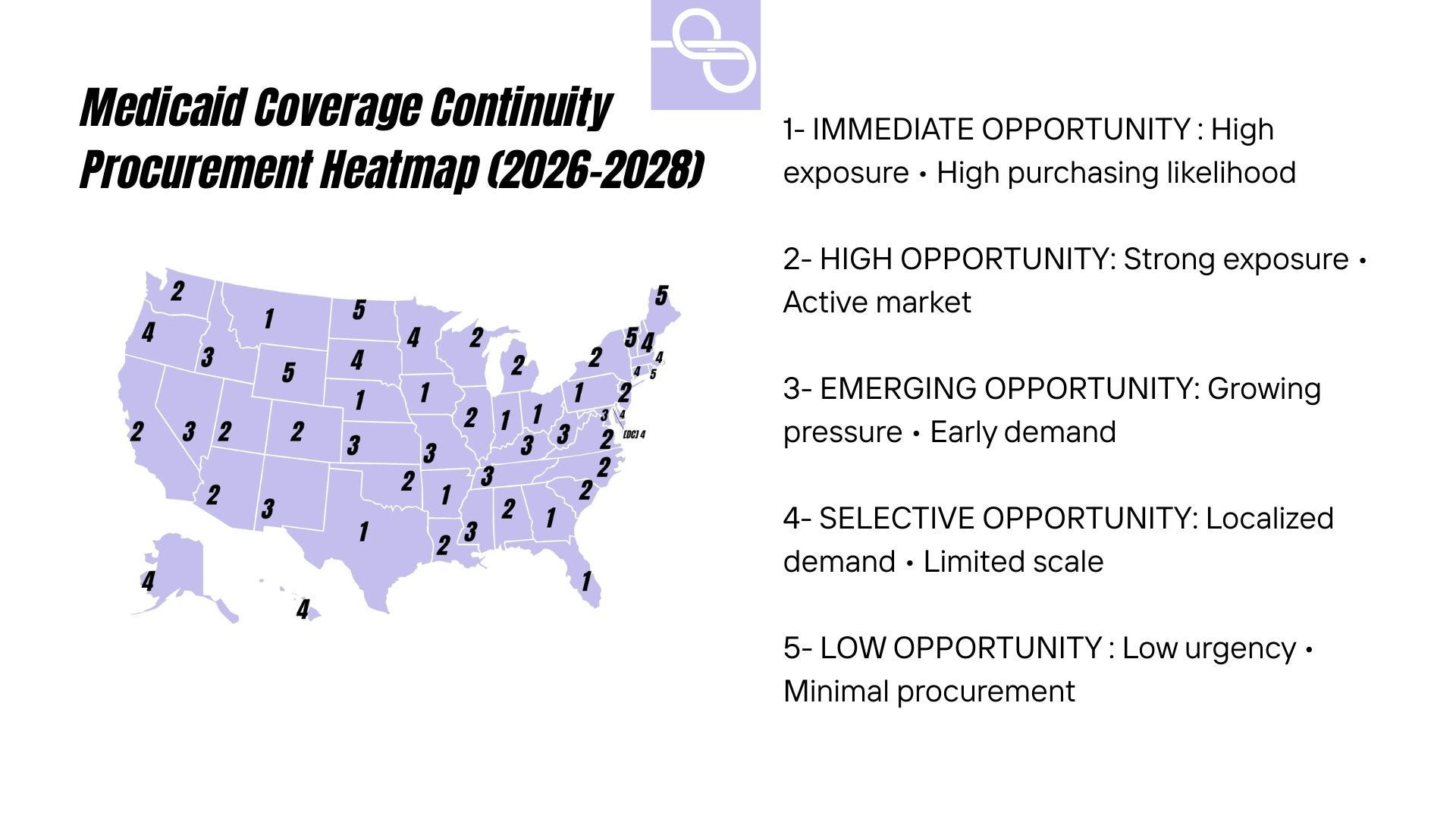
Administrative churn, renewal complexity, work requirements, verification activity, and managed care exposure vary significantly by state. As a result, procurement demand for coverage continuity infrastructure is likely to concentrate in specific markets over the next 24 months.
The map below identifies states where coverage continuity is most likely to become a purchasing decision rather than simply an operational challenge.
Tier Definitions
🟣 Tier 1 — Immediate Opportunity
High exposure • High purchasing likelihood
🟣 Tier 2 — High Opportunity
Strong exposure • Active market
🟣 Tier 3 — Emerging Opportunity
Growing pressure • Early demand
🟣 Tier 4 — Selective Opportunity
Localized demand • Limited scale
⚪ Tier 5 — Low Opportunity
Low urgency • Minimal procurement
Tier 1: Immediate Opportunity
These states combine significant Medicaid enrollment, administrative churn pressure, policy-driven eligibility complexity, and active procurement environments.
Arkansas
Florida
Georgia
Indiana
Iowa
Montana
Nebraska
Ohio
Pennsylvania
Texas
Tier 2: High Opportunity
Large populations, meaningful administrative exposure, and growing procurement readiness.
Alabama
Arizona
California
Colorado
Illinois
Louisiana
Michigan
New Jersey
New York
North Carolina
Oklahoma
South Carolina
Utah
Virginia
Washington
Wisconsin
Tier 3: Emerging Opportunity
Operational pressure is building, but procurement activity remains less mature.
Idaho
Kansas
Kentucky
Maryland
Mississippi
Missouri
Nevada
New Mexico
Tennessee
West Virginia
Tier 4: Selective Opportunity
Coverage continuity remains relevant but purchasing activity is likely to be targeted and localized.
Alaska
Connecticut
Delaware
District of Columbia
Hawaii
Massachusetts
Minnesota
New Hampshire
Oregon
South Dakota
Tier 5: Low Opportunity
Smaller populations, lower churn exposure, or limited near-term procurement pressure.
Maine
North Dakota
Rhode Island
Vermont
Wyoming
What This Means
Not all Medicaid churn creates the same purchasing environment.
Some states face significant coverage instability but have limited procurement pathways. Others combine administrative pressure, financial exposure, managed care incentives, and active contracting environments that make coverage continuity investments increasingly attractive.
The strongest near-term opportunities appear concentrated in states where policy pressure, enrollment scale, and reimbursement exposure are converging simultaneously.
These states are likely to define the next generation of coverage continuity procurement.
TOP SOLUTIONS

Pull Score: 24 / 31
Trend: ⇈
Position: Category Incumbent
Strengths
Strongest visible procurement footprint in the category
National payer relationships
24M+ members supported
Benefits continuity expertise
Immediate reimbursement preservation logic
Watch
Limited independent outcome validation
Pricing opacity

Pull Score: 24 / 31
Trend: ⇈
Position: Enterprise Infrastructure
Strengths
60+ health plans
60M+ covered lives
Dual eligibility optimization
LIS/MSP/SSI enrollment expertise
Large-scale reimbursement preservation
Watch
Methodology transparency
Limited payer-authored validation

Pull Score: 26 / 31
Trend: ⇈
Position: Administrative Churn Infrastructure
Strengths
Reinstatement and churn-recovery focus
Reported capitation preservation outcomes
Same-cycle revenue protection logic
MMIS-integrated workflows
Watch
Limited public contract visibility
Independent validation remains limited

Pull Score: 25 / 31
Trend: ⇈
Position: Renewal & Eligibility Continuity Platform
Strengths
Renewal completion workflows
Document collection infrastructure
Virtual mailbox functionality
Member-facing administrative support
Strong provider revenue-cycle alignment
Watch
Procurement maturity still developing
Long-term competitive durability remains unproven
WHO IS BUYING?
Medicaid Managed Care Organizations
Primary value:
Member-month preservation
Premium retention
Reduced procedural churn
Reinstatement recovery
Enrollment stability
Providers & Health Systems
Primary value:
Reduced uncompensated care
Coverage restoration
Revenue-cycle protection
Eligibility continuity
State Agencies
Primary value:
Administrative workload reduction
Renewal completion
Verification support
Call-center pressure reduction
Eligibility-processing efficiency
CATEGORY OUTLOOK
Coverage continuity is increasingly being evaluated as a distinct operational and procurement challenge rather than a subset of enrollment, care management, or member-services functions.
Several forces are contributing to that shift. Renewal frequency is increasing. Verification requirements are expanding. Work requirements introduce additional administrative workflows. At the same time, plans, providers, and state agencies are facing greater financial exposure when eligible individuals lose coverage because renewal, documentation, or eligibility processes are not completed successfully.
Unlike many social-care categories, the value proposition is tied to an event that occurs within the current contract cycle. Coverage is either maintained or it is not. Eligibility is either restored or it is not. Member months are either preserved or lost. As a result, performance can often be evaluated through operational and financial outcomes that are visible long before downstream utilization effects emerge.
The organizations highlighted in this category differ in their workflows, target populations, and operating models. What they share is a focus on reducing administrative coverage loss and preserving continuity of enrollment. As policy requirements and eligibility processes become more complex, these capabilities appear increasingly relevant to Medicaid managed care organizations, providers, and state agencies responsible for maintaining coverage continuity across large populations.
The category is still developing. Procurement pathways are becoming clearer, buyer demand is becoming easier to identify, and the underlying economic rationale is increasingly visible. The long-term competitive hierarchy remains unsettled, but the operational problem is unlikely to become less important.