Which social care models get stronger as healthcare data improves?
The largest beneficiaries of better healthcare data may be some of the oldest interventions in social care.

Good evening,
What interests me most about today’s discussions on Medicaid work requirements is the realization that the healthcare system is being asked to produce information it often doesn’t have.
Claims data can tell you someone has cancer, multiple sclerosis, HIV, or a recent hospitalization. It can tell you which medications were filled, which diagnoses were documented, and how often someone used healthcare services. What it generally cannot tell you is whether those conditions significantly impair a person’s ability to work.
Yet the new rule increasingly hinges on functionality. Healthcare has encountered versions of this challenge before. Functionality shapes access to long-term care services and disability benefits. From a frontline perspective, it also sits at the center of decisions involving involuntary psychiatric hospitalization, county guardianship, and post-acute placement. The difference between what a person has and what a person can do often determines whether an inpatient stay lasts three days or three months.
That turns a policy debate into a data problem.
Healthcare organizations are being asked to generate, verify, and defend evidence about a person’s functional capacity. Some of the most useful information may not come from claims at all. It may come from social workers documenting daily functioning after discharge, care managers tracking transportation barriers and caregiver support, or social care programs capturing realities that rarely appear in a billing record.
Which raises a larger question.
If healthcare is becoming better at measuring the realities of daily life, which social care models gain the most value as those measurement systems improve?
While National Health Data Week centers on interoperability, patient matching, artificial intelligence, and data standards, many Medicaid and social care leaders are paying attention for a different reason.
Every improvement in healthcare data changes what can be measured, and every change in measurement eventually changes what gets purchased.
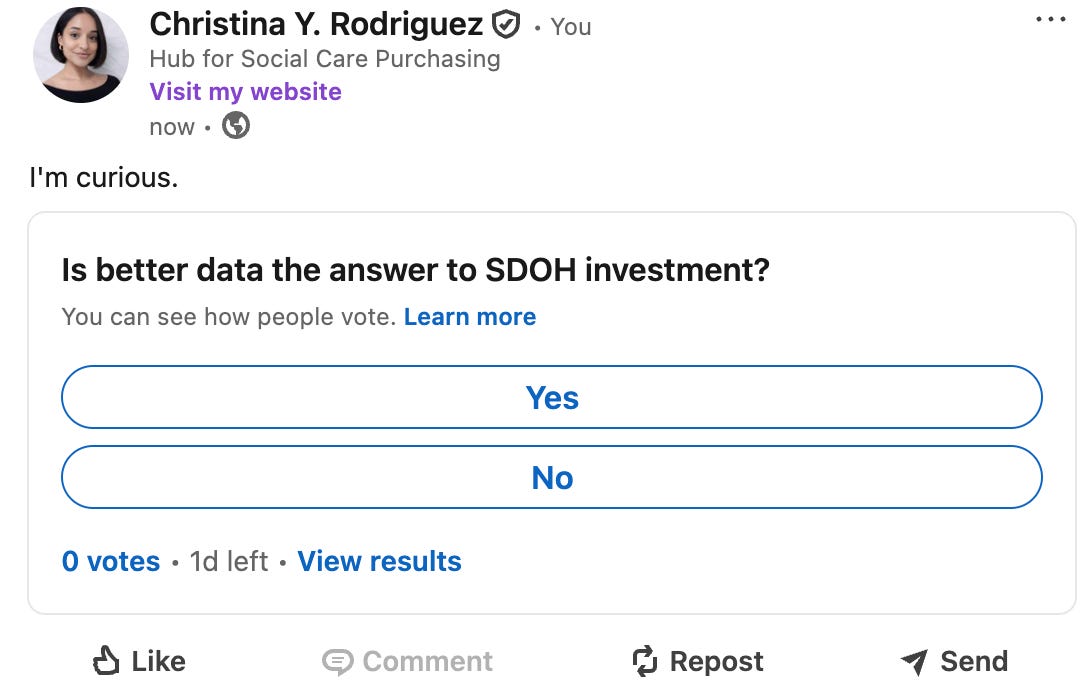
So, which social care models gain the most value as healthcare becomes better at measuring what happens?
Better healthcare data should benefit referral platforms, interoperability vendors, analytics companies, and the broader infrastructure layer responsible for moving information across fragmented systems.
Yet recent developments suggest something more interesting may be happening.
California now reimburses medically tailored meals, housing supports, transportation, and other community services through its In Lieu of Services framework. Massachusetts has incorporated Health-Related Social Needs services into MassHealth. Community Servings can point to published analyses linking medically tailored meals to lower utilization and lower spending. None of those developments changed the intervention itself. Meals remained meals. Transportation remained transportation. What changed was healthcare’s ability to document who received a service, connect the intervention to utilization data, and evaluate outcomes inside an accountability framework.
The largest beneficiaries of better healthcare data may not be the organizations building the newest technology. They may be some of the oldest interventions in social care.
LIVE: POLL